Show me an example Latest Ford Fiesta S1600 limited edition: automotive
car
Showing posts with label automotive. Show all posts

Sunday, February 6, 2011

Meet The Newest V12 Lamborghini

Lamborghini isn’t letting us see their latest V12 supercar up close and personal until next month’s Geneva Motor Show, but that didn’t stop them from leaking the above image of the new car in camo guise. The good news is that this test mule isn’t clad in black vinyl, so we get a decent feel for the lines of the car. If this is the final design, I have to say two thumbs up; Lamborghini had been going down a bizarre styling path lately (case in point: the Reventon), and this car pulls them back to center. You can see the influences from Murcielago, but I’m also seeing heritage here. The muscular front fenders remind me of the iconic Countach, but in a more evolved manner.

Lamborghini’s latest will be built using a carbon fiber monocoque, and will utilize a pushrod suspension similar to F1 cars for more precise control. The car will be powered by a 6.5 liter V12, said to be good for 691 horsepower and 509 ft lb of torque. Like newer Ferraris, buyers won’t get the option of a traditional manual gearbox; instead, the car will come only with a single clutch, automated manual gearbox. Drivers can select between Strada (Street) mode, which will shift like a conventional automatic transmission unless manually shifted; Sport mode, which will hold gears longer and quicken upshifts and Corsa (Track) mode, which includes launch control and provides the most extreme driving experience. To ensuring that the power gets to the ground, the new Lambo is AWD and includes a computer-controlled front differential, a Haldex4 center differential and a rear diff integrated into the engine casting to save weight. We promise more pics and more details after the Geneva Motor Show.

Teaser Super Bowl Commercial from Volkswagen: The Force

Every year millions of us sit in front of the TV to witness not only a great Super Bowl game, but great commercials. One series of commercials that is expected to be among the best this year comes from the folks at Volkswagen. The teaser Volkswagen commercial appropriately named ‘The Force’ features a pint-sized Darth Vader who uses the Force when he discovers the new 2012 Passat. This one won’t disappoint. Enjoy!

The ‘Pawn Stars’ Crew On The 2011 Ford Explorer

The hottest show on television these days, at least in terms of ratings, is quite likely the History Channel’s mega-hit “Pawn Stars”. The show follows the exploits of the staff of Las Vegas’ Gold and Silver pawn shop, and it’s chock full of funny. You could try to write a sitcom like this, but you’d never get it right and viewers would never believe the stuff that comes in the door. What better way to highlight the differences between the 2010 and 2011 Ford Explorers than to hire the staff of Gold and Silver to treat it like an appraisal?


These guys are used to scams, since everyone is Las Vegas is working some kind of angle. The setup has the announcer trying to pass off a 2010 Explorer as the all-new 2011 version, and each of the staff get to point out key differences. Rick spots the exposed door keypad on the 2010, which is hidden on the 2011. Corey demonstrates that the 2010 Explorers didn’t get the My Ford Touch option, and The Old Man points out that the 2010’s V6 was down 80 horsepower on the 2011 V6. Cut to Cro-Magnon Man Chumlee rolling up in a 2011 Explorer, which they all agree is the real deal. Until they see the grille logo.

Props to Ford for jumping on the Pawn Stars bandwagon, and a tip of the hat to the guys at Pawn Stars. They’ve been in Vegas long enough to know that fame is fleeting, so you may as well enjoy the spotlight as long as you can.

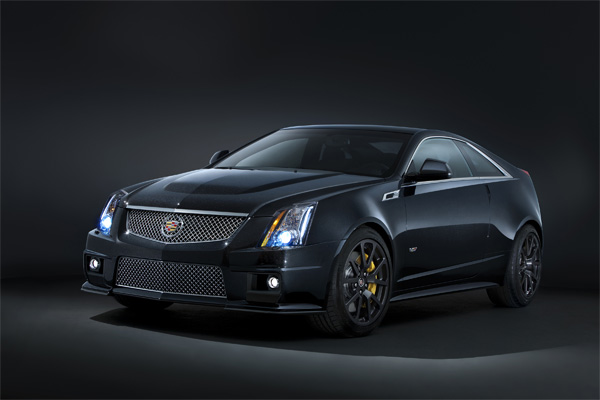
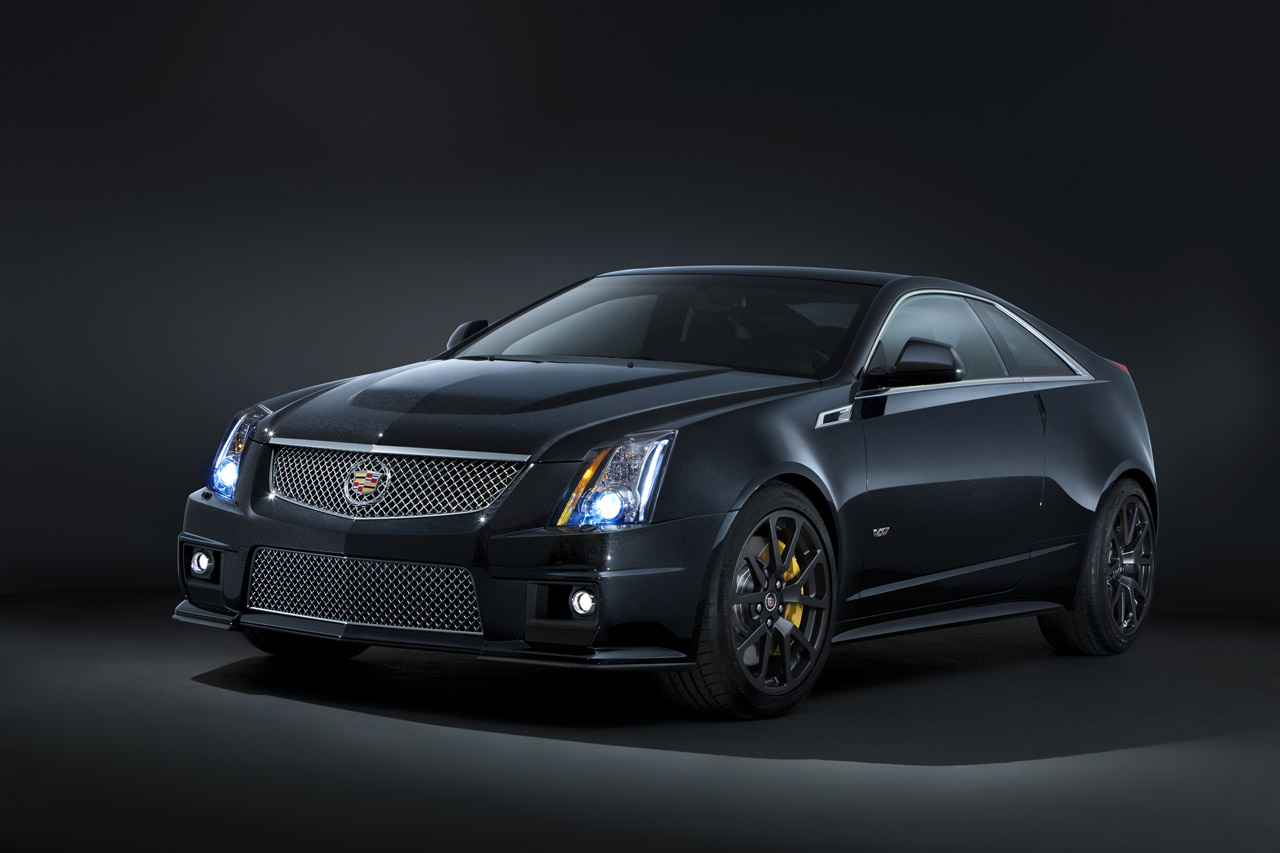
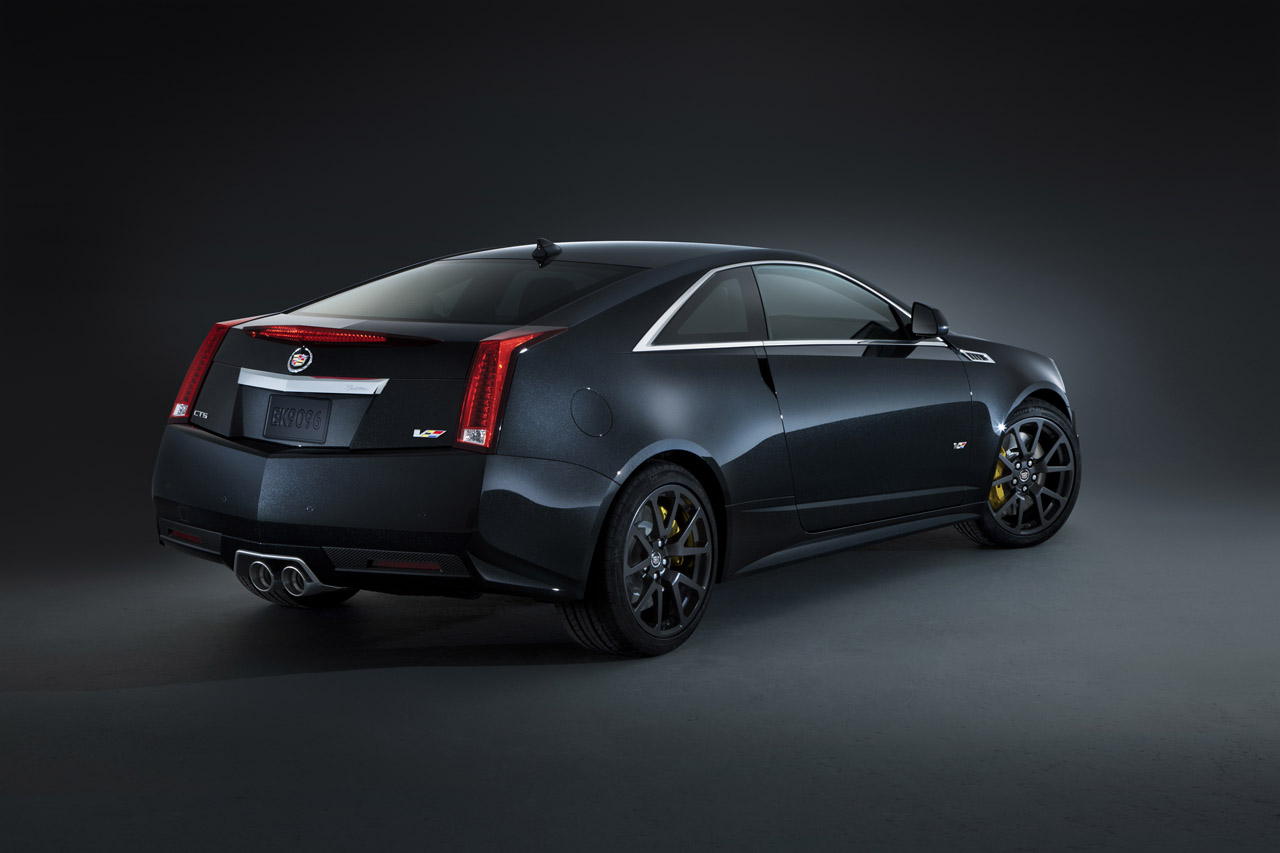
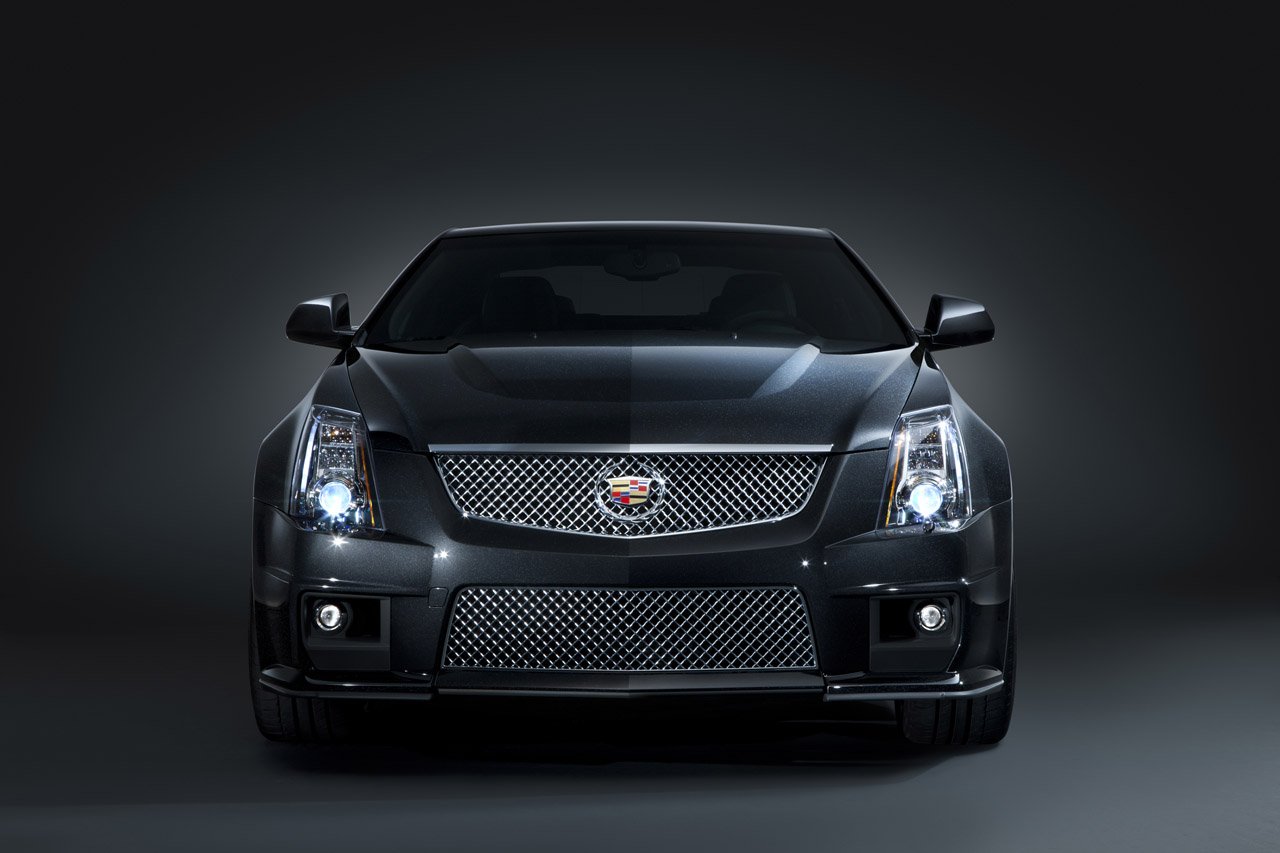
Cadillac Announces CTS-V Black Diamond Edition

The 2011 Black Diamond CTS-V Coupe. Image: © GM Corp.

When it comes to colors, I’ll generally pick black, at least until something darker comes along. Maybe it’s because things just look better in black, or maybe it matches the color of my soul. When it comes to favorite American cars, Cadillac’s CTS-V series is near the very top of my list. Combine the two, and you definitely get my attention; apparently, Cadillac thinks the way I do, because they’ve just announced a special edition of the CTS-V, called the Black Diamond Edition.


The Black Diamond Edition, which will be available in the sedan, coupe and wagon variants, starts with a special multi-layered paint. The black tri-coat paint gets blended with microscopic aluminum flakes, embedded in magnesium fluoride. That’s the science part, but the net result is a finish of unmatched depth and dimension that shines like a diamond in the sunlight. To complete the exterior look, Black Diamond Edition CTS-Vs roll on Satin Graphite 19 inch wheels, and get yellow-painted Brembo calipers.

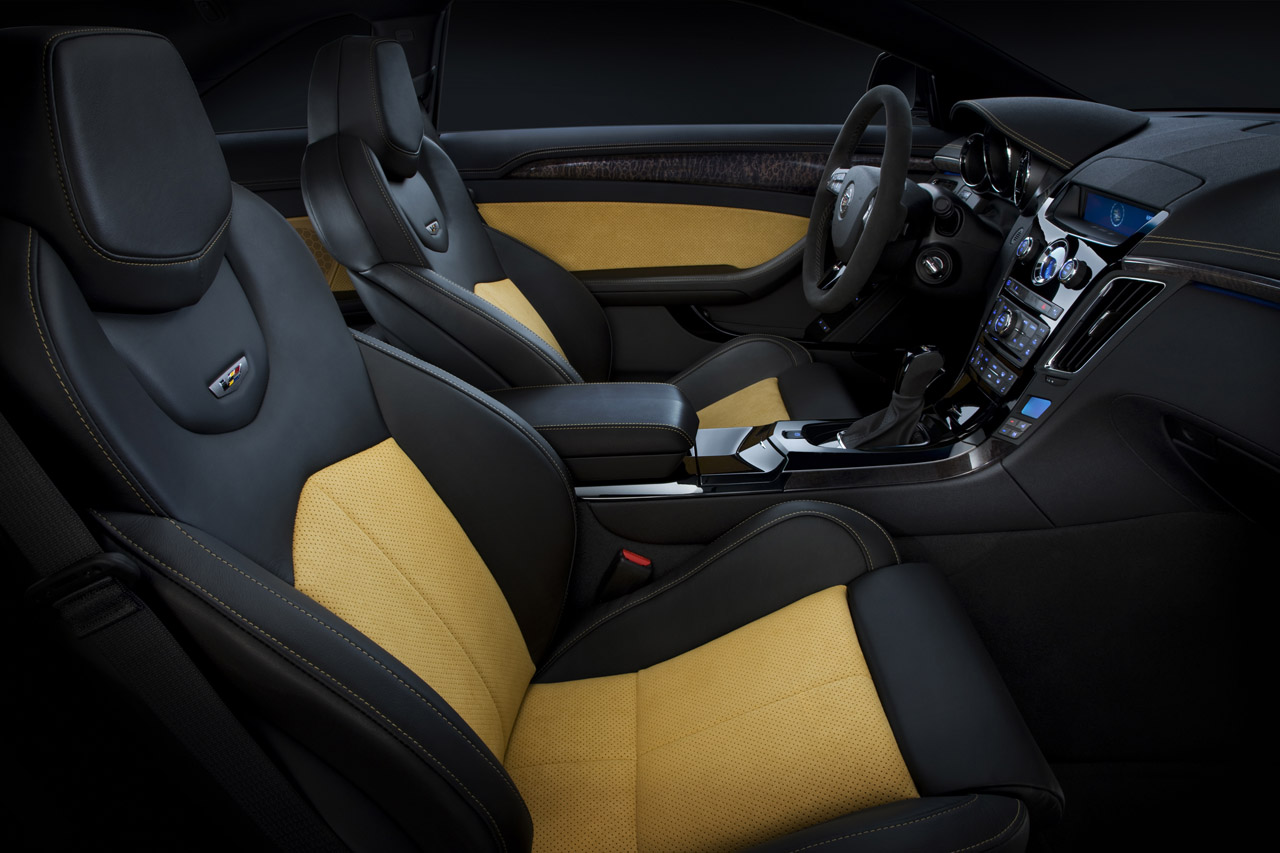
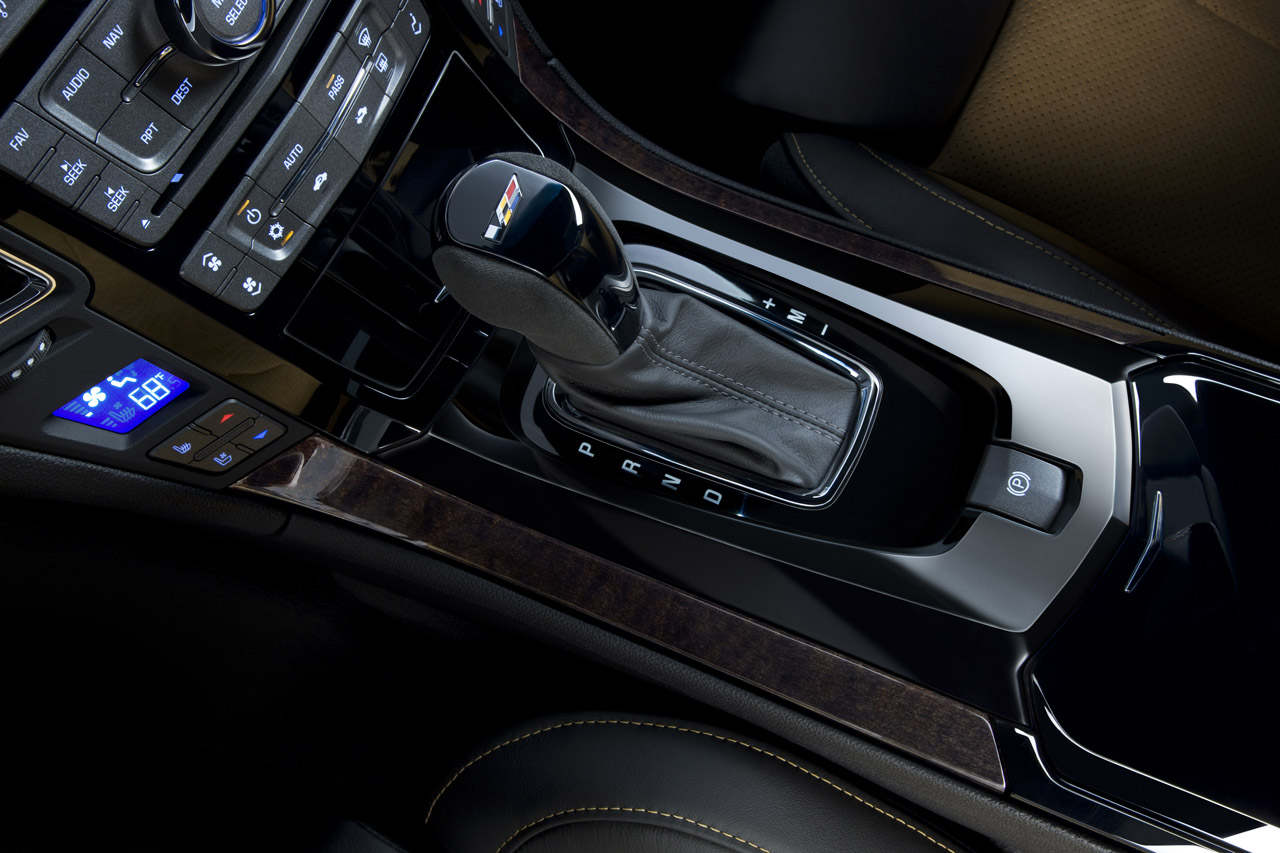
On the inside, the special edition cars come with the superb Recaro seats and Midnight Sapele wood trim. Coupe buyers can opt for the “Saffron” interior, but I’d pass since even the microfiber suede inserts take away from the inherent blackness of the car. It looks like the suede steering wheel is standard on Black Diamond cars, and that’s a good thing.


If there’s a disappointment, it’s just that Cadillac didn’t do a thing to the motor on these special edition cars. Not that an engine producing 556 horsepower needs much improvement, but still; you’re paying for a “better” car, but it’s just an appearance package. Pricing on the CTS-V Black Diamond Edition, regardless of body style, is $69,190 for the six speed (yes, please) and $70,490 for the (oddly faster) automatic. That’s a premium of $4,850 over a base CTS-V, but it’s less than the sum of all the upgrades it includes. If I hit the lottery, you can rest assured I’ll be in to snap up a Black Diamond Edition CTS-V sedan.

Super Bowl Car Ads: I’d Score It Kia 1, Chevy 0

Let’s face it: if your team isn’t playing in the Super Bowl, half the game’s entertainment value is going to come from the ads. Every single advertiser pulls out all the stops to film a budget-blowing spot for the Super Bowl, because it ensures they’ll get their product in front of millions of beer and hot-wing fueled television viewers. Short of staging your own halftime “wardrobe malfunction”, there’s no better way to build brand awareness than with a Super Bowl ad that stands above the rest.

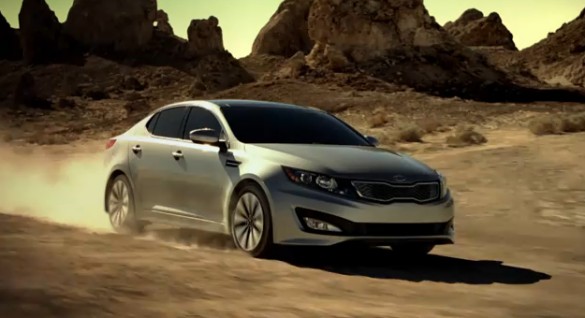
Kia is on a roll these days, launching one successful new model after another. The new Optima is a stunning car, and its quality is on par with anything else on the market these days. Kia’s already known for their Super Bowl ads, since it’s kind of hard to forget a marital aid getting down with a sock monkey on a road trip. How to top that for this year? I won’t spoil the video (below), but I’ll say this: it’s got super villains, aliens, and hopped up Mayans (or Aztecs; I always get them confused).


Chevy’s ad for the Camaro, on the other hand, just doesn’t cut the mustard. Sure, it’s got good visuals (and a stunning blond), but where’s the plot? where’s the build-up, where’s the conflict, where’s the resolution? Why do I get the feeling that the narrative is exactly how the ad agency came up with the idea? Like the bulk of their “Chevy Runs Deep” ads, this one just leaves me scratching my head and thinking about what could have been.

2011 Buick Regal CXL Turbo Review & Test Drive

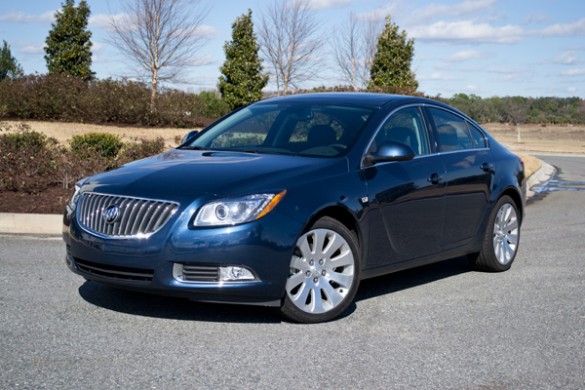
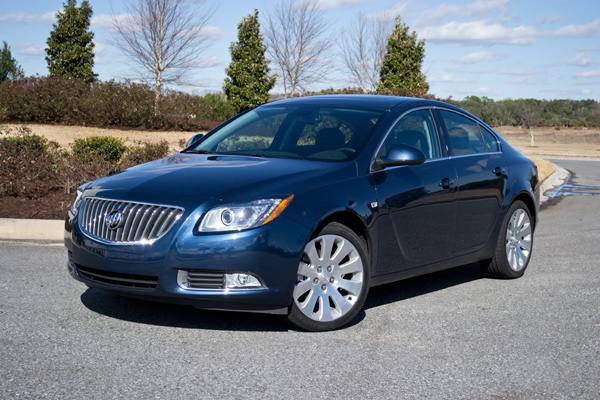
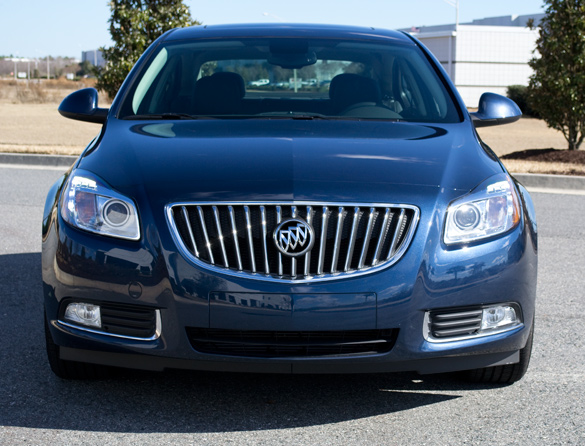
The first time I heard that the new Buick Regal was making a return to the American market I suspected something lumpy and sterile, nothing close to the category of cool. I was totally shocked when I first saw the new 2011 Regal in person. It reminded me once again that GM as reemerged as a ‘better’ and stronger car company and there is a particular GOOD reason for further developing vehicles for the Buick line.

The new 2011 Buick Regal is far from your grandparents Buick (or parents depending how old you are). Buick has had a tradition of being that car from GM that catered more towards the older crowd, but a few things have changed. The 2011 Regal further puts emphasis on a mainstream car make that could even have those in their mid 20’s perusing vehicles at your local Buick dealership.

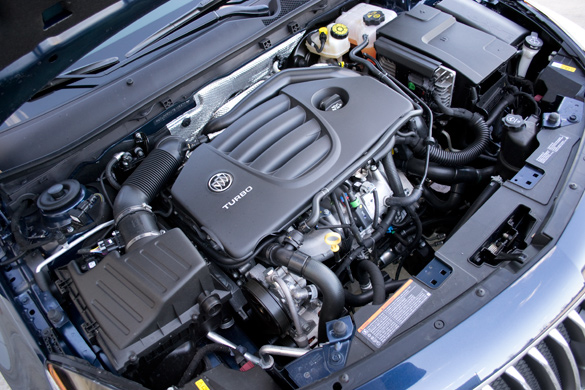
The new Buick Regal is based off of the European Opel Insignia which has been a big seller for about one year overseas. The Regal and LaCrosse both benefit from the Insignia platform which brings German-bred characteristics to the forefront. Driving in the 2011 Regal is enjoyable, and the power that comes from my test vehicle’s 2.0-liter turbocharged 220 horsepower and 258 pound-feet of torque engine adds to that pleasure. The real relaxing part of the drive is the optional Interactive Drive Control, which is essentially GM’s active suspension dampening system with a fancy name.

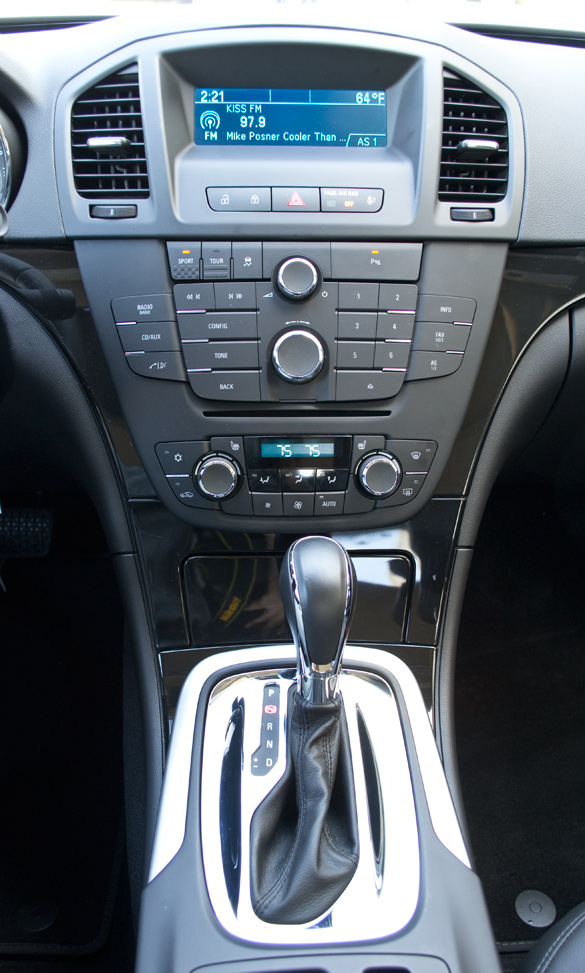
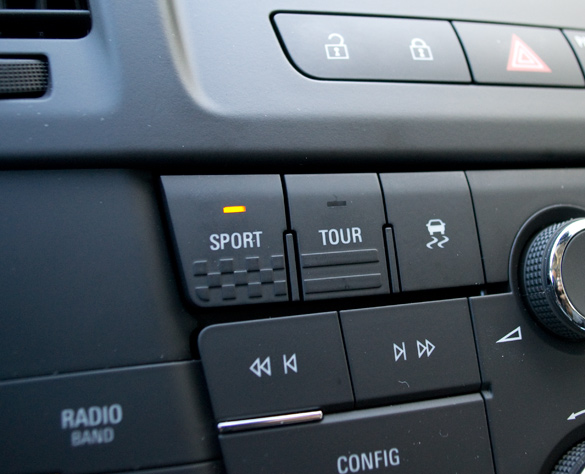
Having an active dampening system, or what Buick calls the Interactive Drive Control, gives the driver three different suspension shock damping settings. The three settings (sport, normal, and touring), are all very distinctly different in order to optimize the feedback you get from different road surfaces. Sport mode will noticeably stiffen the shocks giving the Regal a subtle bouncy ride along with tightening the steering response for an over-all sporty feeling. Normal mode is activated by default when starting the vehicle offering a balanced feel for any driving situation. Touring mode optimizes the suspension for a relaxed feel and lightens the steering effort. Overall, the 2011 Regal CXL optioned with the Interactive Drive Control system gives you a competent sports sedan that can be toned down for comfy long trips.

On the road, my Buick Regal CXL Turbo has somewhat inconsistent power from its 2-liter Turbo 4 banger. Although it has adequate torque, the over-all power delivery comes on in clumps rather than in a smooth fashion. The steering feel is extremely over-sensitive by nudging the vehicle at the slightest turn of the wheel at slow cruising speeds and at highway speeds. Luckily the handling of the Regal is forgiving by understeer when pushed to the limit into a turn. The traction control and stability control is not overly intrusive to upset balance when going hot into a turn. That could be due in part to the bigger 19-inch wheels wrapped in 235/45 Goodyear Eagle RS-A rubber as part of the optional equipment package on my test car.

The Turbo engine is mated to a smooth 6-speed transmission. 0-60 times are not exactly quick, just over 8 seconds, which may have been hindered due to the 6-speed transmission not shifting as fast as I would have liked. Nevertheless, the Regal Turbo is able to move just over 3700 pounds without too much of a strain. I expected gas mileage to be exceptional but I could only muster out almost 24mpg on average during my 300 mile highway trip. The Regal CXL Turbo is rated for 18mpg city and 28mpg highway.

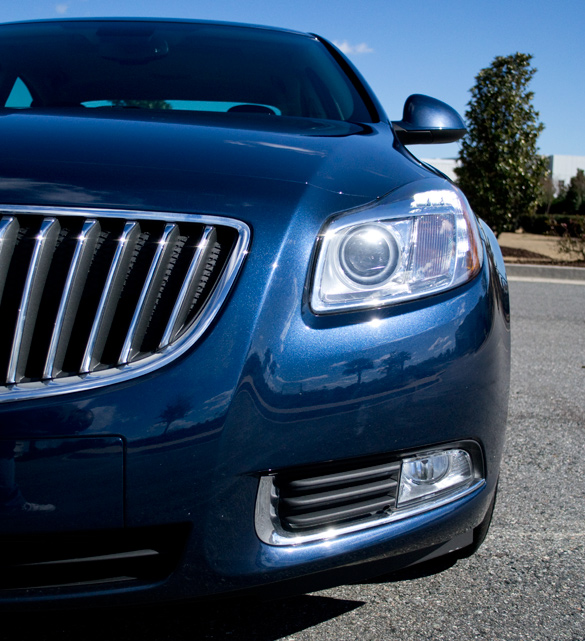
Outside of the new 2011 Regal you will find an attractive and somewhat sporty look. The large 19 inch wheels really blend well with the 107-inch wheel base and bubbly shaped silhouette. I am not sure if the look of the Regal CXL Turbo would draw the attention to young buyers. That may be something the new Regal GS will accomplish when it makes its debut in America as a 2012 model.

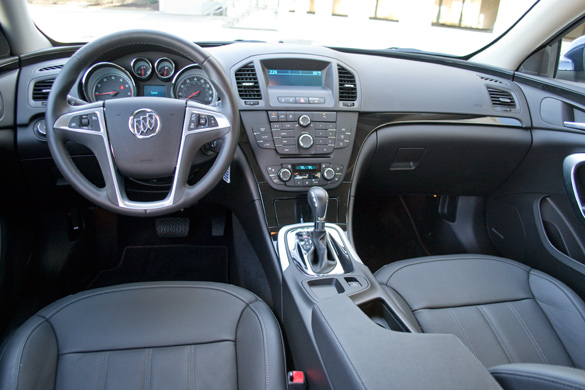
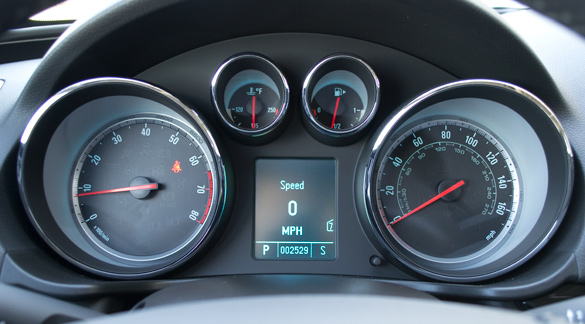
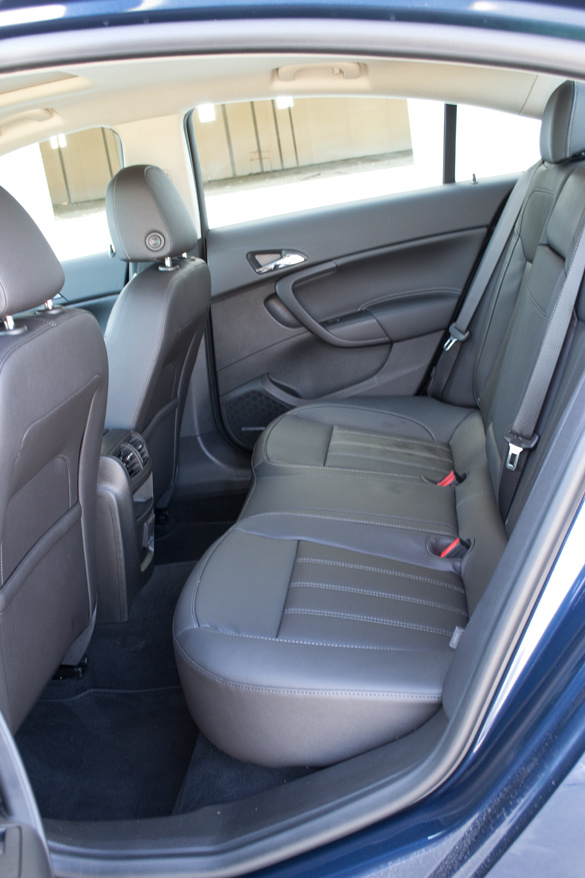
The interior as several soft touch accents and soft buttons that add a very nice quality feel to the Regal. This will do wonders for GM if they keep it up. Inside you will also find a brightly lit instrument cluster that has a subtle retro look to it with a fine point needle indicator for the speedometer and tachometer. The dashboard somewhat fades into the background due to all of the black. Just about everything on the dash is black until nighttime falls and you get to read the brightly illuminated buttons.

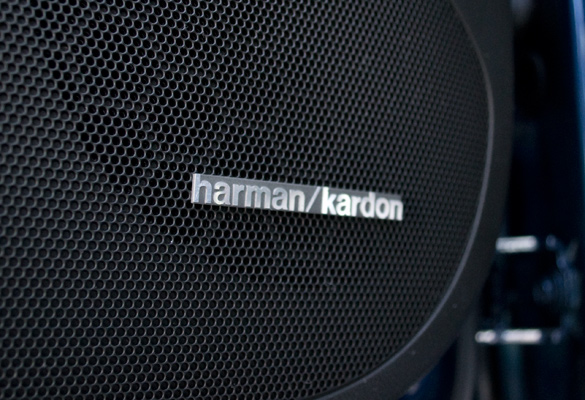
Some notable options found on my Regal tester, part of the T06 Optional Equipment package, was an excellent Harmon Kardon premium 9 speaker sound system, Interactive Drive Control (active dampening system), HID headlights and a power sunroof. With these options it brings the Regal CXL Turbo to an as-tested price of $32.440. A base Buick Regal CXL with a 2.4-liter 4-cyl engine starts at $26,245 which comes with a long list of standard features.

Buick is obviously chasing after vehicles such as the Acura TSX, Lincoln MKZ, Volvo S60, VW CC and even the Lexus IS250 without losing its combined German and American heritage. So far I would say the 2011 Regal CXL Turbo is a justifiable contender that could take the crown.


Wednesday, December 15, 2010

Mini Cooper: Mini Mini rumored to be in the works


Post by: Automotive

Wolfgang Armbrecht, head of BMW's Mini brand recently hinted that a smaller small car may be in the works. In an interview with Germany's Financial Times Deutschland, Ampbrecht admitted that Mini may develop a small car for parent company BMW. We've actually heard these rumors before when talk sprang up about the potential for a BMW 0 Series.

If the thought of a Mini Mini crossed with BMW parts makes you excited, you're not alone. Who could say 'No' to the Ultimate Go-Karting Machine? As of yet however, there are no reports of a build timeline or potential specs, but a glimpse of what's to come is said to be earmarked for next month's Detroit Auto Show.

source: Mini Cooper Press

Monday, May 3, 2010

Car Specifications: Audi R8 GT

Post by: Car Specifications
- Limited-production, top-of-the-line version of the high performance sports car
- 100 pounds lighter, the carbon body parts
- V10 FSI with 412 kW (560 hp), 0-100 km / h in 3.6 seconds

Ingolstadt, now even stronger, lighter and faster: displays the version of the Audi R8's limited production high performance sports cars, GT R8. Output from the 5.2-liter V10 has been increased to 412 kW (560 hp), vehicle weight has been reduced by approximately 100 kilograms (£ 220.46). GT R8 accelerates from zero to 100 km / h (62.14 mph) in 3.6 seconds and reaches a top speed of 320 km / h (198.84 mph).

The R8 high-performance sports cars have a winner from scratch. This applies to both the production model, winner of the "World Performance Car" Award in 2008 (R8) and in 2010 (R8 V10), and racing cars, with the LMS R8, which won 23 races in his first season and claimed three championships. The genes from the version now comes to road races - the GT R8. Exclusive series limited to 333 units. Every GT R8 has a badge with a production number on the shift key lever.

Consistent use of lightweight construction: 100 kilograms (220.46 pounds), trimmed

production R8 5.2 FSI quattro has been a successful example of Audi's lightweight construction philosophy. Its aluminum Audi Space Frame (ASF) body weighs just 210 kilograms (462.97 pounds). aluminum body panels joined to the frame with extruded profiles and cast nodes through a positive and frictional connection. Machine framework is made of ultra lightweight magnesium.

ASF body largely hand-built at the Neckarsulm factory complex in the manufacturing process. Very high strength body is the basis for the proper handling of high-performance sports cars, and also offer good comfort and safety first class crash vibration.

Thanks to ASF body, the production R8 5.2 FSI quattro weighs only 1625 kilograms (3,582.51 lb) - with all-wheel drive quattro permanent and optional R Tronic transmission. This makes it all the more difficult for the engineers to once again achieve substantial weight savings. They took a complicated approach that involves every aspect of vehicle, and eventually came to rest in the scales 1 525 kilograms (3,362.05 lb).

R8 GT windshield made of thinner glass, while the cell bulkhead between the passenger and engine compartments, and windows in the rear doors are made of strong, lightweight polycarbonate. All three modifications are saved nine kilograms (19.84 pounds). Rear wing is still good for an additional 1.2 kilograms (2.65 pounds); thin sheets of metal and pieces of shaved additional 2.6 kilograms (5.73 pounds) of aluminum hatch for containers 100 liters (3.53 cubic feet) baggage at the front of the car.

Long rear hatch is made of carbon fiber reinforced plastic (CFRP) - a gain of 6.6 kilograms (14.55 pounds). And the rear bumper of the same material sideblades save an additional 5.2 and 1.5 kilograms (11.46 and 3.31 pounds), respectively. With minimal weight and high strength, CFRP is an ideal material for a high-performance sports car, and Audi has extensive expertise in its use.

The engineers are also striving to shave every possible gram of weight of the technical components of R8. They shaved one kilogram (2.20 pounds) from the power brake system, four kilograms (8.82 pounds) of aluminum cap from the brake discs and 9.4 kilograms (20.72 pounds) of batteries. The engineers also found 2.3 kilograms (5.07 pounds) of air intake modules and 2.8 kilograms (6.17 pounds) in isolation of the engine compartment.

interior is also great potential to save weight-savings. The new, lightweight carpets account for 7.9 kilograms (17.42 lb) bucket seats with a chassis, glass reinforced plastic (GRP) account for 31.5 kilograms (69.45 pounds). Detailed a number of additional steps that targeted the interior, exterior and technology, such as a higher class, for mild steel exhaust system tailpipes.

Even sharper and more effective: design

Audi R8 GT design is an expression of concentrated power - a beautiful, technical statue measuring 4.43 meters (14.53 feet) long, 1.93 meters (6.33 feet) wide and only 1.23 meters (4.04 feet) high . It suffered a lot of exterior modifications that further refine the appearance. Many of them also reduce weight and improve aerodynamics. R8 generates more downforce GT when compared with the rapid production model driven - without an increase in the value of Cd (0.36) or the frontal region (1.99 m2) (21.42 square feet).

From single-frame grille frames, struts and blades in the air intake finished in matt titanium gray; matt black painted grille. The splitter below the bumper has a double lip and made of carbon. Slender, curved flics on the corner of the nose to increase downforce on the front axle and also made of carbon fiber composites.

One highlight of the R8 GT is standard LED lamps, the use of light emitting diodes for all functions. They produce bright, uniform light, has a long service life and low energy consumption. Lighting also has an attractive and distinctive appearance. Daytime running lights each consist of 24 LEDs and appear as a continuous band. The reflectors are reminded open clam shells.

Defining element of the display is sideblades, which direct air to the engine in the R8 and GT also made of carbon matte. The same materials used for housing to reduce the size of the side mirror mounted on aluminum base. 19-inch wheels feature an exclusive design of twin five-spoke Y in titanium-look finish. Sport front fender "GT" badges.

Modifications to the back of the car is very obvious, beginning with a fixed-wing carbon matte. ventilation curtains at either side of the rear door and bumper CFRP, which integrates a large circular tailpipes, and vents to the wheel wells, have been redesigned. Larger diffuser is made of carbon fiber composites, panels and license plates in the back of the blade width in matte gray titanium. Its tail lights, which also uses LED technology, has been housing the dark with clear glass panels.

Audi R8 GT offers a choice of four body colors: Orange Metallic Samoa, Suzuka Gray Metallic, Silver Ice Metallic Phantom Black pearl effect and

Breathtakingly powerful: with 412 kW (560 hp), 5.2 FSI

The V10 is modified, which includes the cylinder head is painted red, Audi R8 provides the GT performance of the heart. The sprint GT R8 from start up to highway speed in 3.6 seconds and from zero to 200 km / h (124.27 mph) in 10.8 seconds. And encourages not leave until the top speed of 320 km / h (198.84 mph) is reached.

Changes to the electronic engine coaxed an extra 26 kW of cylinder-ten, which now produces 412 kW (560 hp) from a displacement of 5204 cc. Torque curve peaks at 540 Nm (398.28 pounds-ft) at 6,500 rpm, 10 Nm (£ 7.38-ft) is more than the production version. This V10 has a specific power output of 79.2 kW (107.6 hp) per liter displacement. power-to-weight ratio is 3.70 kilograms (8.16 pounds) per kW, or 2.72 kg (6.00 pounds) per-hp. The engine redlines at 8700 rpm.

Long-stroke engine (bore x stroke 84.5 x 92.8 mm [3.33 x 3.65 in]), which was built in hand-factory in Győr, Hungary, features crankcase made of aluminum-silicon alloys are lightweight and excellent strength. A bedplate - a frame for the crankshaft bearing bridge - further increase its stiffness. Complete engine weighs just 258 kilograms (568.79 pounds). This is marked with a cylinder angle of 90 degrees and dry lubrication-bah, which uses a highly efficient oil pump module. Both solutions reduce the center of gravity and thus improve driving dynamics.

crankshaft is designed as a pivot pin general. Which connects the piston rod opposite the crankpin involving public, resulting in the firing intervals alternately 54 and 90 degrees. This unique rhythms provide an attractive V10 sound - music, very technical grand like that in racing. Two flaps in the exhaust system and tone adjust the volume as a function of engine speed and load.

Normally aspirated engines consume an average of 13.7 liters of fuel per 100 km (17.17 U.S. mpg) - fuel economy very good given extraordinary powers. FSI petrol direct injection system injects fuel into the combustion chamber up to 120 bar pressure. Turbulent mixture cool the cylinder wall, allowing the compression ratio of 12.5:1. A variable intake manifold and continuous adjustment of the chain-driven camshaft ensures that the combustion chamber is fully filled. Flaps in the intake ports to facilitate the formation of the mixture by pushing the movement in the air falling revenues.

The drivetrain: uncompromising traction

Gear changes in the GT R8 is handled by the R Tronic sequential manual transmission. Electrohydraulic clutch and switching units receive their orders electronically. It changes gear faster than the six-skilled driver can - in a tenth of a second at high loads and engine speeds.

Electronic management system offers automatic with Sport mode and the characteristics of Normal, and two manual level. This is controlled using the gear selector lever briefly about the central tunnel and two paddles in the steering wheel. Maximum thrust when the launch is guaranteed by the Launch Control - a program that manages a full engine acceleration at high speed and minimum wheel slip when starting.

permanent quattro all-wheel-drive is an ideal technology for a high-performance sports car. Viscous clutch located in front of the center sends 15 percent of the difference in power to the front axle and 85 percent to the rear wheels during normal driving. This split harmonizes perfectly with 43:57 weight distribution which Audi R8 GT's per cent. clutch send as many as 30 percent of power to the front wheels in milliseconds, if necessary. A mechanical locking differential on the rear axle further improve traction. This provides a restriction to 25 percent when the acceleration and up to 40 percent in the attack.

Even tauter chassis and more precise

The Audi R8 high-performance GT sports car driving machine with a heart of lateral acceleration and lightning-fast, almost instantaneous reaction. mid-mounted engine is close to the vertical axis; mass almost negligible during the change of direction quickly. GT R8 is a dynamic, precise and stable in almost every situation.

This followed the racing chassis design classic - double wishbones made out of aluminum to find wheels. That is, hydraulic power-assisted rack-and-wing has a ratio 16.3:1 steering wheel connects the driver directly and intimately and exactly the road. A manually adjustable coilover suspension, which lowers the body as much as 10 millimeters (0.39 in), is standard. a higher front and rear wheel camber make the level of infestation is more agile handling than the standard model.

Forged 19-inch wheels 8.5 J x 19 front and 11 J x 19 at the rear, and shod with size 235/35 and 295/30 tires, respectively. Audi 305/30 tires will increase along with the optional wheels on the rear axle on demand. Cup tires, which offer the ultimate in performance on dry roads, is available for race fans.

Audi mountain internally ventilated, carbon fiber ceramic brake discs standard. They are extremely durable and abrasion resistance and especially light. Together they weight nine kilograms (19.84 pounds) less than their steel counterparts of the same size. They measure 380 mm (14.96 in) in diameter in front and 356 mm (14.02 in) at the rear. Who fled to the friction ring helmets through elastic elements. Red brake calipers anodized aluminum - with six pistons at the front - which is exclusive to the GT R8.

ESP stabilization program specifically for the GT R8 and can switch to Sport mode simply by pressing a button to allow spectacular, but safe, oversteer when accelerating out of corners. The driver can deactivate the system fully for the trip to the race track.

Exclusive and dynamic: the interior and equipment

At Audi, reducing weight means better performance and efficiency, but does not sacrifice. The Audi R8 GT, which sells Audi in Germany for € 193,000, is equipped with automatic climate control system and power windows, navigation system with MMI operating logic and a powerful sound system. A 465 watt, ten-channel Bang & Olufsen sound system, CD changer and Audi Music Interface is available as an option. As usual with Audi, the interior show a loving attention to detail. Rich materials pamper occupants with the look and feel smoother.

Interior ergonomics are decorated in a sporty black and dark gray. Wheel steering, main, roofing paper, the knee, the parking brake lever and bucket seats covered in Alcantara with contrast stitching accents. A shark leather-look synthetic that feels a bit rough to touch it applied to the bulkhead, door liners, the monks and dashboard instruments. The monoposto "" - the arch in the cockpit - is made of matt carbon.

Groups of instruments features a white fast with "R8 GT" badge. Newly designed selector lever is made of CFRP and aluminum; center tunnel and door liners sports with body color of decorative inlays. The frame of the door trims feature decorated with matt aluminum R8 GT "logo.

A number of features that are only available as an option for the GT R8. Exterior options include two alternative wheel, a body-color front splitter and the engine compartment of the CFRP layer. carbon element at the doors, and tunnels, in the cockpit and instrument panel are available as interior choices. Others include leather multifunction steering wheel, a belt of red, orange or gray, floor mats with GT R8 "" logo and trim CFRP doorway illuminated in red. If desired, Audi will fit the frame carbon seat, which is somewhat lighter than the bullet CFRP. Alcantara seat covers are optionally available with the GT "embroidered R8" logo.

Race packages available for racing fans. These include bolt-in roll bar red or black, the latter path and type approval, as well as road-approved four-point belt, red or black, fire extinguishers and kill switches for the battery. A front panel for optional modules covering key motorsports balanced swivel for four-point seat belts, and change the roll bar into a full cage. Looking for more comfort and convenience of the buyer can select the phone preparation with a microphone, an innovative belt. Audi also offers a full leather package, elements of control in leather with contrasting stitching and cruise control system as options. Parking assistance provided with standard equipment.

source: Audi Press
 

Car Specifications: Audi R8 GT

Post by: Car Specifications
- Limited-production, top-of-the-line version of the high performance sports car
- 100 pounds lighter, the carbon body parts
- V10 FSI with 412 kW (560 hp), 0-100 km / h in 3.6 seconds

Ingolstadt, now even stronger, lighter and faster: displays the version of the Audi R8's limited production high performance sports cars, GT R8. Output from the 5.2-liter V10 has been increased to 412 kW (560 hp), vehicle weight has been reduced by approximately 100 kilograms (£ 220.46). GT R8 accelerates from zero to 100 km / h (62.14 mph) in 3.6 seconds and reaches a top speed of 320 km / h (198.84 mph).

The R8 high-performance sports cars have a winner from scratch. This applies to both the production model, winner of the "World Performance Car" Award in 2008 (R8) and in 2010 (R8 V10), and racing cars, with the LMS R8, which won 23 races in his first season and claimed three championships. The genes from the version now comes to road races - the GT R8. Exclusive series limited to 333 units. Every GT R8 has a badge with a production number on the shift key lever.

Consistent use of lightweight construction: 100 kilograms (220.46 pounds), trimmed

production R8 5.2 FSI quattro has been a successful example of Audi's lightweight construction philosophy. Its aluminum Audi Space Frame (ASF) body weighs just 210 kilograms (462.97 pounds). aluminum body panels joined to the frame with extruded profiles and cast nodes through a positive and frictional connection. Machine framework is made of ultra lightweight magnesium.

ASF body largely hand-built at the Neckarsulm factory complex in the manufacturing process. Very high strength body is the basis for the proper handling of high-performance sports cars, and also offer good comfort and safety first class crash vibration.

Thanks to ASF body, the production R8 5.2 FSI quattro weighs only 1625 kilograms (3,582.51 lb) - with all-wheel drive quattro permanent and optional R Tronic transmission. This makes it all the more difficult for the engineers to once again achieve substantial weight savings. They took a complicated approach that involves every aspect of vehicle, and eventually came to rest in the scales 1 525 kilograms (3,362.05 lb).

R8 GT windshield made of thinner glass, while the cell bulkhead between the passenger and engine compartments, and windows in the rear doors are made of strong, lightweight polycarbonate. All three modifications are saved nine kilograms (19.84 pounds). Rear wing is still good for an additional 1.2 kilograms (2.65 pounds); thin sheets of metal and pieces of shaved additional 2.6 kilograms (5.73 pounds) of aluminum hatch for containers 100 liters (3.53 cubic feet) baggage at the front of the car.

Long rear hatch is made of carbon fiber reinforced plastic (CFRP) - a gain of 6.6 kilograms (14.55 pounds). And the rear bumper of the same material sideblades save an additional 5.2 and 1.5 kilograms (11.46 and 3.31 pounds), respectively. With minimal weight and high strength, CFRP is an ideal material for a high-performance sports car, and Audi has extensive expertise in its use.

The engineers are also striving to shave every possible gram of weight of the technical components of R8. They shaved one kilogram (2.20 pounds) from the power brake system, four kilograms (8.82 pounds) of aluminum cap from the brake discs and 9.4 kilograms (20.72 pounds) of batteries. The engineers also found 2.3 kilograms (5.07 pounds) of air intake modules and 2.8 kilograms (6.17 pounds) in isolation of the engine compartment.

interior is also great potential to save weight-savings. The new, lightweight carpets account for 7.9 kilograms (17.42 lb) bucket seats with a chassis, glass reinforced plastic (GRP) account for 31.5 kilograms (69.45 pounds). Detailed a number of additional steps that targeted the interior, exterior and technology, such as a higher class, for mild steel exhaust system tailpipes.

Even sharper and more effective: design

Audi R8 GT design is an expression of concentrated power - a beautiful, technical statue measuring 4.43 meters (14.53 feet) long, 1.93 meters (6.33 feet) wide and only 1.23 meters (4.04 feet) high . It suffered a lot of exterior modifications that further refine the appearance. Many of them also reduce weight and improve aerodynamics. R8 generates more downforce GT when compared with the rapid production model driven - without an increase in the value of Cd (0.36) or the frontal region (1.99 m2) (21.42 square feet).

From single-frame grille frames, struts and blades in the air intake finished in matt titanium gray; matt black painted grille. The splitter below the bumper has a double lip and made of carbon. Slender, curved flics on the corner of the nose to increase downforce on the front axle and also made of carbon fiber composites.

One highlight of the R8 GT is standard LED lamps, the use of light emitting diodes for all functions. They produce bright, uniform light, has a long service life and low energy consumption. Lighting also has an attractive and distinctive appearance. Daytime running lights each consist of 24 LEDs and appear as a continuous band. The reflectors are reminded open clam shells.

Defining element of the display is sideblades, which direct air to the engine in the R8 and GT also made of carbon matte. The same materials used for housing to reduce the size of the side mirror mounted on aluminum base. 19-inch wheels feature an exclusive design of twin five-spoke Y in titanium-look finish. Sport front fender "GT" badges.

Modifications to the back of the car is very obvious, beginning with a fixed-wing carbon matte. ventilation curtains at either side of the rear door and bumper CFRP, which integrates a large circular tailpipes, and vents to the wheel wells, have been redesigned. Larger diffuser is made of carbon fiber composites, panels and license plates in the back of the blade width in matte gray titanium. Its tail lights, which also uses LED technology, has been housing the dark with clear glass panels.

Audi R8 GT offers a choice of four body colors: Orange Metallic Samoa, Suzuka Gray Metallic, Silver Ice Metallic Phantom Black pearl effect and

Breathtakingly powerful: with 412 kW (560 hp), 5.2 FSI

The V10 is modified, which includes the cylinder head is painted red, Audi R8 provides the GT performance of the heart. The sprint GT R8 from start up to highway speed in 3.6 seconds and from zero to 200 km / h (124.27 mph) in 10.8 seconds. And encourages not leave until the top speed of 320 km / h (198.84 mph) is reached.

Changes to the electronic engine coaxed an extra 26 kW of cylinder-ten, which now produces 412 kW (560 hp) from a displacement of 5204 cc. Torque curve peaks at 540 Nm (398.28 pounds-ft) at 6,500 rpm, 10 Nm (£ 7.38-ft) is more than the production version. This V10 has a specific power output of 79.2 kW (107.6 hp) per liter displacement. power-to-weight ratio is 3.70 kilograms (8.16 pounds) per kW, or 2.72 kg (6.00 pounds) per-hp. The engine redlines at 8700 rpm.

Long-stroke engine (bore x stroke 84.5 x 92.8 mm [3.33 x 3.65 in]), which was built in hand-factory in Győr, Hungary, features crankcase made of aluminum-silicon alloys are lightweight and excellent strength. A bedplate - a frame for the crankshaft bearing bridge - further increase its stiffness. Complete engine weighs just 258 kilograms (568.79 pounds). This is marked with a cylinder angle of 90 degrees and dry lubrication-bah, which uses a highly efficient oil pump module. Both solutions reduce the center of gravity and thus improve driving dynamics.

crankshaft is designed as a pivot pin general. Which connects the piston rod opposite the crankpin involving public, resulting in the firing intervals alternately 54 and 90 degrees. This unique rhythms provide an attractive V10 sound - music, very technical grand like that in racing. Two flaps in the exhaust system and tone adjust the volume as a function of engine speed and load.

Normally aspirated engines consume an average of 13.7 liters of fuel per 100 km (17.17 U.S. mpg) - fuel economy very good given extraordinary powers. FSI petrol direct injection system injects fuel into the combustion chamber up to 120 bar pressure. Turbulent mixture cool the cylinder wall, allowing the compression ratio of 12.5:1. A variable intake manifold and continuous adjustment of the chain-driven camshaft ensures that the combustion chamber is fully filled. Flaps in the intake ports to facilitate the formation of the mixture by pushing the movement in the air falling revenues.

The drivetrain: uncompromising traction

Gear changes in the GT R8 is handled by the R Tronic sequential manual transmission. Electrohydraulic clutch and switching units receive their orders electronically. It changes gear faster than the six-skilled driver can - in a tenth of a second at high loads and engine speeds.

Electronic management system offers automatic with Sport mode and the characteristics of Normal, and two manual level. This is controlled using the gear selector lever briefly about the central tunnel and two paddles in the steering wheel. Maximum thrust when the launch is guaranteed by the Launch Control - a program that manages a full engine acceleration at high speed and minimum wheel slip when starting.

permanent quattro all-wheel-drive is an ideal technology for a high-performance sports car. Viscous clutch located in front of the center sends 15 percent of the difference in power to the front axle and 85 percent to the rear wheels during normal driving. This split harmonizes perfectly with 43:57 weight distribution which Audi R8 GT's per cent. clutch send as many as 30 percent of power to the front wheels in milliseconds, if necessary. A mechanical locking differential on the rear axle further improve traction. This provides a restriction to 25 percent when the acceleration and up to 40 percent in the attack.

Even tauter chassis and more precise

The Audi R8 high-performance GT sports car driving machine with a heart of lateral acceleration and lightning-fast, almost instantaneous reaction. mid-mounted engine is close to the vertical axis; mass almost negligible during the change of direction quickly. GT R8 is a dynamic, precise and stable in almost every situation.

This followed the racing chassis design classic - double wishbones made out of aluminum to find wheels. That is, hydraulic power-assisted rack-and-wing has a ratio 16.3:1 steering wheel connects the driver directly and intimately and exactly the road. A manually adjustable coilover suspension, which lowers the body as much as 10 millimeters (0.39 in), is standard. a higher front and rear wheel camber make the level of infestation is more agile handling than the standard model.

Forged 19-inch wheels 8.5 J x 19 front and 11 J x 19 at the rear, and shod with size 235/35 and 295/30 tires, respectively. Audi 305/30 tires will increase along with the optional wheels on the rear axle on demand. Cup tires, which offer the ultimate in performance on dry roads, is available for race fans.

Audi mountain internally ventilated, carbon fiber ceramic brake discs standard. They are extremely durable and abrasion resistance and especially light. Together they weight nine kilograms (19.84 pounds) less than their steel counterparts of the same size. They measure 380 mm (14.96 in) in diameter in front and 356 mm (14.02 in) at the rear. Who fled to the friction ring helmets through elastic elements. Red brake calipers anodized aluminum - with six pistons at the front - which is exclusive to the GT R8.

ESP stabilization program specifically for the GT R8 and can switch to Sport mode simply by pressing a button to allow spectacular, but safe, oversteer when accelerating out of corners. The driver can deactivate the system fully for the trip to the race track.

Exclusive and dynamic: the interior and equipment

At Audi, reducing weight means better performance and efficiency, but does not sacrifice. The Audi R8 GT, which sells Audi in Germany for € 193,000, is equipped with automatic climate control system and power windows, navigation system with MMI operating logic and a powerful sound system. A 465 watt, ten-channel Bang & Olufsen sound system, CD changer and Audi Music Interface is available as an option. As usual with Audi, the interior show a loving attention to detail. Rich materials pamper occupants with the look and feel smoother.

Interior ergonomics are decorated in a sporty black and dark gray. Wheel steering, main, roofing paper, the knee, the parking brake lever and bucket seats covered in Alcantara with contrast stitching accents. A shark leather-look synthetic that feels a bit rough to touch it applied to the bulkhead, door liners, the monks and dashboard instruments. The monoposto "" - the arch in the cockpit - is made of matt carbon.

Groups of instruments features a white fast with "R8 GT" badge. Newly designed selector lever is made of CFRP and aluminum; center tunnel and door liners sports with body color of decorative inlays. The frame of the door trims feature decorated with matt aluminum R8 GT "logo.

A number of features that are only available as an option for the GT R8. Exterior options include two alternative wheel, a body-color front splitter and the engine compartment of the CFRP layer. carbon element at the doors, and tunnels, in the cockpit and instrument panel are available as interior choices. Others include leather multifunction steering wheel, a belt of red, orange or gray, floor mats with GT R8 "" logo and trim CFRP doorway illuminated in red. If desired, Audi will fit the frame carbon seat, which is somewhat lighter than the bullet CFRP. Alcantara seat covers are optionally available with the GT "embroidered R8" logo.

Race packages available for racing fans. These include bolt-in roll bar red or black, the latter path and type approval, as well as road-approved four-point belt, red or black, fire extinguishers and kill switches for the battery. A front panel for optional modules covering key motorsports balanced swivel for four-point seat belts, and change the roll bar into a full cage. Looking for more comfort and convenience of the buyer can select the phone preparation with a microphone, an innovative belt. Audi also offers a full leather package, elements of control in leather with contrasting stitching and cruise control system as options. Parking assistance provided with standard equipment.

source: Audi Press
 

Friday, April 9, 2010

Car Specifications: Ferrari 599 GTO

Post by: Car Specifications
Maranello, www.ferrari.com is now available on the first photo and information about the new 599 GTO, extreme V12 Berlinetta developed for a brief orientation on specific performance. The 599 GTO, in fact, the fastest ever road car company. This is an exclusive special limited edition, in true Ferrari tradition, is an entirely new concept, although inspired by a production car. Actually based on the 599XX 599 GTO, the car advanced experimental songs, and can be considered almost road-going version.

GTO 599 599 are provided only for clients who are looking for maximum expression of high-performance driving. 599 GTO directly benefit from the transfer of technology from racing and set the record at Fiorano lap time in 1'24 ".


Fiorano lap time to provide only one indication of the potential of this car. Just as significant are the technical specifications - 670 hp in a 1495kg car is a ratio of weight-for-the power of only 2.23 kg / hp, and ensure the 0-100 km / h acceleration time of just 3.35 "and a top speed of more than 335 km / h

Fundamental to the performance of GTO is an innovative approach to developing the chassis, for the first time on a production car, saw the integration between the handling of the set-up according to the level of response which is close to the limit and very sophisticated electronic controls. The result is nearly complete lack of understeer and chassis really communicative.

Like Ferrari's policy, any new features Ferrari's new solutions for road cars. So the 599 GTO is equipped with the latest, second generation carbon-ceramic brakes are lighter and offer better performance, new aerodynamic innovations, such as wheel donuts that increase aerodynamic efficiency and to improve brake cooling, and Supersport tire developed by Michelin, including a wider front tire for greater roadholding. Driver interface is also new to the implementation of the Virtual Race Engineer (VRE) that provides drivers with immediate information on the performance.

599 GTO is more aggressive character also appears in a number of elements which recall the style of 599XX and a strong voice from the V12.

The GTO (Gran Turismo Omologata) moniker direct calls to mind both the Ferrari that has entered the collective imagination as a symbol of performance. After the 1962 250 GTO, which swept the board in GT racing category in 1960 and is now a very valuable collector's car, came by its iconic 1984 GTO, which basically created a whole genre of modern supercars.

Special web including photos, videos and interviews on a new car, while an exclusive preview to a small number of clients Ferrari will be held on 14 April at the Military Academy in Modena. The public debut of the 599 GTO would likely be in the Beijing International Motor Show in late April.

599 GTO TECHNICAL CONTENTS

Engine and gearbox

GTO 599 engine is derived directly from the unit 599XX execution, but the modifications required for the road-going homologation. Thus, in accordance with the Euro 5 and LEV 2 standards. The 5999 cc 65-degree V12 engine blows out 670 CV at 8250 rpm with maximum torque of 620 Nm at 6500 rpm and there's a rush, smooth constant power all the way to redline with no loss of flexibility even at low and medium revs. This result is obtained by working on-fluid dynamics and components to reduce internal friction and by adopting, inter alia, a redesigned crankshaft 599XX. The car also has a racing-type intake system with a new intake manifold with a geometry diffuser-type and short inlet channel is designed to increase the supply of power at high revs and reduce losses. To maximize the volumetric efficiency per cylinder, Connections between the two plenums in front to compensate the volume variation. This is how the engineers managed to achieve maximum performance at high engine speeds. Engine noise in the car carefully controlled to balance the intake with the exhaust sound, which is equipped with a manifold 6-to-1-derived 599XX.

599 GTO of the same features, lower 60 ms time shift and the possibility to make some downshifts as in the 599XX.

VEHICLE DYNAMICS

One of the most significant innovation of the 599 GTO is a high correlation between the chassis set-up, which is close to the limits of handling, and input from the electronic control was developed to improve the overall performance level.

Because of the very early state of development of two cars', Maranello engineers work to ensure that these two areas of the car will be smooth so that push to limit the integrated response. The result is, of course, the involvement of superlatives and drive a lap faster. Apart from the new pool and bar rear anti-roll stiffness, the car is also equipped with magnetorheological suspension system of the second generation control (SCM2). suspension work closely with the VDC (Vehicle Dynamic Control) and the latest generation of traction control-F1-Trac. This makes the car very responsive to driver input - thanks in part to the application of very direct steering ratio - but also very stable under braking, sharper on turn-in, which is more appropriate in faster cornering and out of the corner.

WEIGHT REDUCTION

599 GTO inherited most of the construction work - by using the same principles as used in F1 - that went into making cars 599XX such extreme performance. Losing weight is an important goal and the result is the extensive use of composites and components manufactured with technology that is more similar to racing specifications. Areas involved include bodywork and in the greenhouse (with thin gauge aluminum and glass thinner), brakes, transmissions and exhaust systems. The result was 1495 kg dry weight and ratio of weight-for-the power of only 2.23 kg / hp, a significant figure that underscores the potential for GTO's performance.

Aerodynamics

599 GTO aerodynamics which has benefited significantly from the experience in F1 and Ferrari engineer with 599XX which allows downforce will be greatly increased without impacting on the drag. Thank you for the solution to be transferred from the car lane road-going version, GTO that produce as much as 144 kg of downforce at 200 km / h. All Cars sharpening, including front, side, the flat underbody and cooling flows. In the second instance, GTO can count increase and ducting to a disc brake pads, and the adoption of a donut wheels - disc position outside the disc brakes which ensure that the hot air out wheelarch remain as close as possible to the car body to reduce drag.

Working on the car's nose was designed to reduce the width of wake generated by the front and thus reduces the drag. Lower front spoiler also has a separate wing that increases downforce on the front of the car and improve airflow to radiator oil cooler. On the sides there is a new threshold leading design more clearly that increases the efficiency of the center of the underbody. The underbody itself combine parts, new lower front with the front diffusers front wheels to optimize downforce, and the double curve of a new rear diffuser.

WHEEL RIM AND Tire

Here's the size difference between the front and rear tires have been changed. The GTO front tire is now 285/30 on 9.5 channels''with 315/35 in 11.5''in the rear channels. 599 GTO has 20''rims. Roll stiffness is greater at the rear to minimize understeer. This solution ensures increased lateral grip and turn a quick login

Brake

The CCM2 new braking system is lighter and even more consistent in high performance situations. Consistent coefficient of friction means that the ABS former can be calibrated to a particularly high level of achievement, further reducing cycle time, thanks to enhanced deceleration and stopping distance is shorter. In fact, it offers 100 599 GTO is very good for 0 km / h braking distance of just 32.5 meters. Like their role in improving the aerodynamics, wheel of a Formula 1 derived from the donut also improve braking efficiency by optimizing the cooling of the brakes.

CAR-DRIVER INTERFACE

Car-driver interface is designed to maximize the performance of the car and driver to the layout of the main command that ensures absolute efficiency and minimum disruption. The manettino Racing also places a strong emphasis on sporty driving track-specific settings by offering drivers a full choice of parameters associated with electronic controls. ICE's position on the 599 GTB Fiorano has been replaced by CT-Off (traction control off). GTO is also equipped with a bespoke, another F1 paddle-carbon fiber to be used more easily in high speed driving. Besides GTO also features a Virtual Race Engineer, a system that monitors the status of the car driver's visibility and provide direct vehicle performance.

GTO 599 technical specifications

DIMENSIONS AND WEIGHT
Length: 4710 mm (185.4 in)
Width: 1962 mm (77.2 in)
Height: 1326 mm (52.2 in)
Wheelbase: 2750 mm (108.3 in)
Front track: 1701 mm (67.0 in)
Rear track: 1618 mm (63.7 in)
* Dry Weight: 1495 kg (3296 pounds)
* Kerb weight: 1605 kg (3538 pounds)
Weight distribution: 47% front - 53% rear
Fuel tank capacity: 105 liters (27.7 U.S. gal/23.1 UK / gal)
Boot Volume: 320 liters (11.3 cu ft)

ENGINE
Type: V12 - 65 °
Bore & stroke: 92 x 75.2 mm (3.62 x 2.96 in)
Unitary displacement: 499.9 cc (30.51 cu in)
Total displacement: 5999 cc (366.08 cu in)
Compression ratio: 11.2:1
Maximum power: 500 kW (670 CV) at 8250 rpm
Maximum torque: 620 Nm (457 pounds / ft) at 6500 rpm

Gearbox
F1 + 6-speed reverse

SUSPENSION
Control SCM2 - Supension Magnetorheological

Tire
Front: 285/30 ZR20''
Rear: 315/35 ZR20''

CARBON-CERAMIC brake
Front: 398 x 38 mm (15.7 x 1.5 in)
Rear: 360 x 32 mm (14.2 x 1.3 ins)

ELECTRONIC CONTROLS
CST with F1-Trac: traction and stability control
TPTMS: Tyre pressure and temperature monitoring system

PERFORMANCE
Maximum speed: more than 335 km / h (over 208 mph)
0-100 km / h (0-62 mph): 3.35 sec

FUEL CONSUMPTION
Combined cycle (ECE) *: 17.5 l/100 km
CO2 emissions
Combined Cycle (ECE) *: 411 g / km
* European Version

source: Ferrari Press

Car Specifications: Ferrari 599 GTO

Post by: Car Specifications
Maranello, www.ferrari.com is now available on the first photo and information about the new 599 GTO, extreme V12 Berlinetta developed for a brief orientation on specific performance. The 599 GTO, in fact, the fastest ever road car company. This is an exclusive special limited edition, in true Ferrari tradition, is an entirely new concept, although inspired by a production car. Actually based on the 599XX 599 GTO, the car advanced experimental songs, and can be considered almost road-going version.

GTO 599 599 are provided only for clients who are looking for maximum expression of high-performance driving. 599 GTO directly benefit from the transfer of technology from racing and set the record at Fiorano lap time in 1'24 ".

Fiorano lap time to provide only one indication of the potential of this car. Just as significant are the technical specifications - 670 hp in a 1495kg car is a ratio of weight-for-the power of only 2.23 kg / hp, and ensure the 0-100 km / h acceleration time of just 3.35 "and a top speed of more than 335 km / h

Fundamental to the performance of GTO is an innovative approach to developing the chassis, for the first time on a production car, saw the integration between the handling of the set-up according to the level of response which is close to the limit and very sophisticated electronic controls. The result is nearly complete lack of understeer and chassis really communicative.

Like Ferrari's policy, any new features Ferrari's new solutions for road cars. So the 599 GTO is equipped with the latest, second generation carbon-ceramic brakes are lighter and offer better performance, new aerodynamic innovations, such as wheel donuts that increase aerodynamic efficiency and to improve brake cooling, and Supersport tire developed by Michelin, including a wider front tire for greater roadholding. Driver interface is also new to the implementation of the Virtual Race Engineer (VRE) that provides drivers with immediate information on the performance.

599 GTO is more aggressive character also appears in a number of elements which recall the style of 599XX and a strong voice from the V12.

The GTO (Gran Turismo Omologata) moniker direct calls to mind both the Ferrari that has entered the collective imagination as a symbol of performance. After the 1962 250 GTO, which swept the board in GT racing category in 1960 and is now a very valuable collector's car, came by its iconic 1984 GTO, which basically created a whole genre of modern supercars.

Special web including photos, videos and interviews on a new car, while an exclusive preview to a small number of clients Ferrari will be held on 14 April at the Military Academy in Modena. The public debut of the 599 GTO would likely be in the Beijing International Motor Show in late April.

599 GTO TECHNICAL CONTENTS

Engine and gearbox

GTO 599 engine is derived directly from the unit 599XX execution, but the modifications required for the road-going homologation. Thus, in accordance with the Euro 5 and LEV 2 standards. The 5999 cc 65-degree V12 engine blows out 670 CV at 8250 rpm with maximum torque of 620 Nm at 6500 rpm and there's a rush, smooth constant power all the way to redline with no loss of flexibility even at low and medium revs. This result is obtained by working on-fluid dynamics and components to reduce internal friction and by adopting, inter alia, a redesigned crankshaft 599XX. The car also has a racing-type intake system with a new intake manifold with a geometry diffuser-type and short inlet channel is designed to increase the supply of power at high revs and reduce losses. To maximize the volumetric efficiency per cylinder, Connections between the two plenums in front to compensate the volume variation. This is how the engineers managed to achieve maximum performance at high engine speeds. Engine noise in the car carefully controlled to balance the intake with the exhaust sound, which is equipped with a manifold 6-to-1-derived 599XX.

599 GTO of the same features, lower 60 ms time shift and the possibility to make some downshifts as in the 599XX.

VEHICLE DYNAMICS

One of the most significant innovation of the 599 GTO is a high correlation between the chassis set-up, which is close to the limits of handling, and input from the electronic control was developed to improve the overall performance level.

Because of the very early state of development of two cars', Maranello engineers work to ensure that these two areas of the car will be smooth so that push to limit the integrated response. The result is, of course, the involvement of superlatives and drive a lap faster. Apart from the new pool and bar rear anti-roll stiffness, the car is also equipped with magnetorheological suspension system of the second generation control (SCM2). suspension work closely with the VDC (Vehicle Dynamic Control) and the latest generation of traction control-F1-Trac. This makes the car very responsive to driver input - thanks in part to the application of very direct steering ratio - but also very stable under braking, sharper on turn-in, which is more appropriate in faster cornering and out of the corner.

WEIGHT REDUCTION

599 GTO inherited most of the construction work - by using the same principles as used in F1 - that went into making cars 599XX such extreme performance. Losing weight is an important goal and the result is the extensive use of composites and components manufactured with technology that is more similar to racing specifications. Areas involved include bodywork and in the greenhouse (with thin gauge aluminum and glass thinner), brakes, transmissions and exhaust systems. The result was 1495 kg dry weight and ratio of weight-for-the power of only 2.23 kg / hp, a significant figure that underscores the potential for GTO's performance.

Aerodynamics

599 GTO aerodynamics which has benefited significantly from the experience in F1 and Ferrari engineer with 599XX which allows downforce will be greatly increased without impacting on the drag. Thank you for the solution to be transferred from the car lane road-going version, GTO that produce as much as 144 kg of downforce at 200 km / h. All Cars sharpening, including front, side, the flat underbody and cooling flows. In the second instance, GTO can count increase and ducting to a disc brake pads, and the adoption of a donut wheels - disc position outside the disc brakes which ensure that the hot air out wheelarch remain as close as possible to the car body to reduce drag.

Working on the car's nose was designed to reduce the width of wake generated by the front and thus reduces the drag. Lower front spoiler also has a separate wing that increases downforce on the front of the car and improve airflow to radiator oil cooler. On the sides there is a new threshold leading design more clearly that increases the efficiency of the center of the underbody. The underbody itself combine parts, new lower front with the front diffusers front wheels to optimize downforce, and the double curve of a new rear diffuser.

WHEEL RIM AND Tire

Here's the size difference between the front and rear tires have been changed. The GTO front tire is now 285/30 on 9.5 channels''with 315/35 in 11.5''in the rear channels. 599 GTO has 20''rims. Roll stiffness is greater at the rear to minimize understeer. This solution ensures increased lateral grip and turn a quick login

Brake

The CCM2 new braking system is lighter and even more consistent in high performance situations. Consistent coefficient of friction means that the ABS former can be calibrated to a particularly high level of achievement, further reducing cycle time, thanks to enhanced deceleration and stopping distance is shorter. In fact, it offers 100 599 GTO is very good for 0 km / h braking distance of just 32.5 meters. Like their role in improving the aerodynamics, wheel of a Formula 1 derived from the donut also improve braking efficiency by optimizing the cooling of the brakes.

CAR-DRIVER INTERFACE

Car-driver interface is designed to maximize the performance of the car and driver to the layout of the main command that ensures absolute efficiency and minimum disruption. The manettino Racing also places a strong emphasis on sporty driving track-specific settings by offering drivers a full choice of parameters associated with electronic controls. ICE's position on the 599 GTB Fiorano has been replaced by CT-Off (traction control off). GTO is also equipped with a bespoke, another F1 paddle-carbon fiber to be used more easily in high speed driving. Besides GTO also features a Virtual Race Engineer, a system that monitors the status of the car driver's visibility and provide direct vehicle performance.

GTO 599 technical specifications

DIMENSIONS AND WEIGHT
Length: 4710 mm (185.4 in)
Width: 1962 mm (77.2 in)
Height: 1326 mm (52.2 in)
Wheelbase: 2750 mm (108.3 in)
Front track: 1701 mm (67.0 in)
Rear track: 1618 mm (63.7 in)
* Dry Weight: 1495 kg (3296 pounds)
* Kerb weight: 1605 kg (3538 pounds)
Weight distribution: 47% front - 53% rear
Fuel tank capacity: 105 liters (27.7 U.S. gal/23.1 UK / gal)
Boot Volume: 320 liters (11.3 cu ft)

ENGINE
Type: V12 - 65 °
Bore & stroke: 92 x 75.2 mm (3.62 x 2.96 in)
Unitary displacement: 499.9 cc (30.51 cu in)
Total displacement: 5999 cc (366.08 cu in)
Compression ratio: 11.2:1
Maximum power: 500 kW (670 CV) at 8250 rpm
Maximum torque: 620 Nm (457 pounds / ft) at 6500 rpm

Gearbox
F1 + 6-speed reverse

SUSPENSION
Control SCM2 - Supension Magnetorheological

Tire
Front: 285/30 ZR20''
Rear: 315/35 ZR20''

CARBON-CERAMIC brake
Front: 398 x 38 mm (15.7 x 1.5 in)
Rear: 360 x 32 mm (14.2 x 1.3 ins)

ELECTRONIC CONTROLS
CST with F1-Trac: traction and stability control
TPTMS: Tyre pressure and temperature monitoring system

PERFORMANCE
Maximum speed: more than 335 km / h (over 208 mph)
0-100 km / h (0-62 mph): 3.35 sec

FUEL CONSUMPTION
Combined cycle (ECE) *: 17.5 l/100 km
CO2 emissions
Combined Cycle (ECE) *: 411 g / km
* European Version

source: Ferrari Press
 

blogger templates | c.r.a.m.a.t